
The Strategic Imperative for AI in Australian Mining
A $2.4 Trillion Industry at an Inflection Point
Australia's mining sector contributed $455 billion to the national economy in the 2023–24 financial year. It employs over 280,000 people directly and supports an ecosystem of suppliers, service providers, and communities that extends into every corner of the continent. By any measure, it is one of the most operationally sophisticated industries on earth.
It is also one of the most strategically unsophisticated in its use of data.
This is not a criticism of capability. Australian mining companies have invested billions in operational technology, autonomous haul trucks, real-time ore grade analysis, predictive maintenance systems, and digital twins of processing plants. At the operational level, the sector's use of data and analytics is genuinely world-class.
But at the strategic level, where decisions about capital allocation, market positioning, portfolio composition, and organisational design are made, the industry remains remarkably reliant on the same tools and processes it used two decades ago. Spreadsheets. Consultant reports. Boardroom intuition calibrated by experience.
The gap between operational data sophistication and strategic data utilisation represents one of the largest unrealised competitive advantages in Australian business.
The Strategic Data Paradox
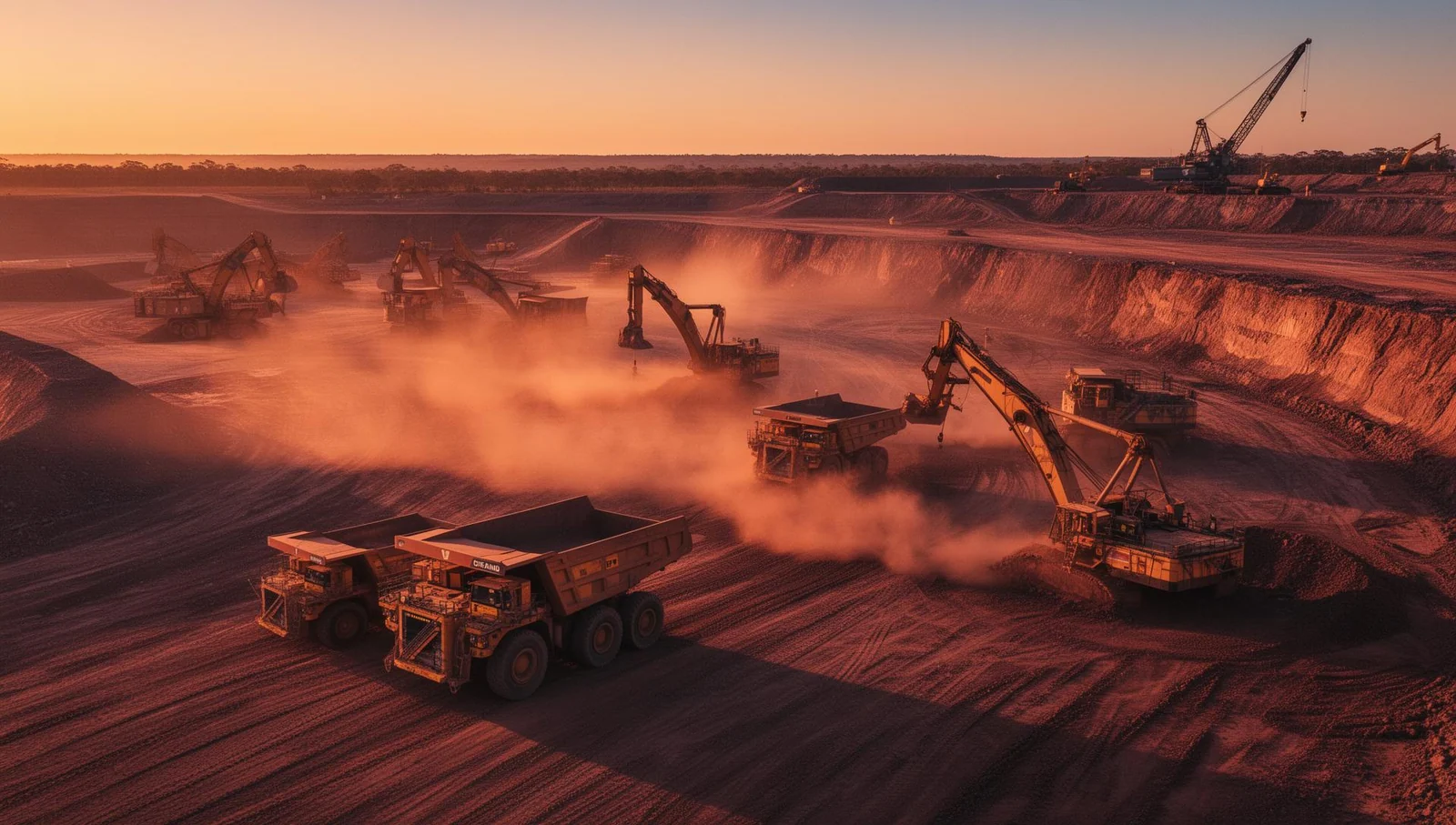
Mining companies generate more operational data per dollar of revenue than almost any other industry. A single open-pit operation produces terabytes of data daily, geological surveys, equipment telemetry, environmental monitoring, production metrics, logistics tracking, and workforce analytics.
Yet when the board convenes to make a $500 million capital allocation decision, the data informing that decision is typically a fraction of what is available. Financial models are built on historical averages and consensus commodity forecasts. Competitive analysis relies on public filings and broker reports. Risk assessment is qualitative rather than quantitative.
The paradox is that the organisations with the most data make their most important decisions with the least data.
This paradox persists for structural rather than intellectual reasons. The people making strategic decisions are typically not the people who understand the operational data. The systems that capture operational data are not connected to the systems that support strategic analysis. And the decision-making processes used at the executive level were designed in an era when processing large, multidimensional datasets in real time was simply not possible.
The Competitive Window
That era has ended. The combination of cloud computing, large language models, and purpose-built analytical platforms means that the technical barriers to AI-augmented strategic decision-making have effectively disappeared. The question is no longer whether it is possible. It is who will move first.
The competitive dynamics of the mining sector amplify the first-mover advantage. Mining is a capital-intensive, long-cycle industry where the consequences of strategic decisions compound over years and decades. A company that improves the quality of its capital allocation decisions by even a modest margin, say, 10 to 15 percent better risk-adjusted returns, will compound that advantage across every investment cycle.
Over a decade, the difference between a company making AI-augmented strategic decisions and one relying on traditional processes will not be marginal. It will be structural.
What AI-Augmented Strategy Looks Like in Practice
Consider three domains where AI integration into strategic decision-making produces measurable value for mining companies.
Portfolio Optimisation. Mining companies typically manage portfolios of assets across multiple commodities, geographies, and lifecycle stages. The traditional approach to portfolio review involves annual or biannual assessment using discounted cash flow models built on consensus price forecasts. AI-augmented portfolio analysis can continuously model hundreds of scenarios, varying commodity prices, exchange rates, regulatory conditions, and operational parameters simultaneously, to identify portfolio compositions that maximise risk-adjusted returns under uncertainty.
Capital Allocation. The mining sector's capital allocation track record is, by the industry's own admission, poor. The Boston Consulting Group's analysis of mining investment decisions found that approximately 60 percent of major capital projects in the sector delivered returns below the cost of capital. AI-powered analysis can improve capital allocation by processing a broader range of variables, including geological uncertainty, infrastructure interdependencies, and market microstructure, than traditional financial models accommodate.
Stakeholder and Regulatory Strategy. Mining companies operate in an increasingly complex stakeholder environment encompassing indigenous communities, environmental groups, regulators, and local governments. AI-powered analysis of regulatory trends, stakeholder sentiment, and political risk can inform more sophisticated engagement strategies, moving from reactive compliance to proactive positioning.
The Organisational Challenge
The technical capability to deploy AI in strategic decision-making exists today. The binding constraint is organisational, not technological.
Mining companies that successfully integrate AI into their strategic processes share three characteristics. First, they have executive sponsors who understand AI's strategic value, not just its operational applications. Second, they invest in structured decision-making frameworks that provide the architecture within which AI tools operate. AI without process discipline produces noise, not insight. Third, they build internal capability rather than outsourcing AI strategy to technology vendors whose commercial incentives are misaligned with the client's strategic objectives.
The companies that treat AI as a technology procurement exercise, buying tools without building the organisational capability to use them strategically, will be disappointed. The companies that treat AI as a catalyst for upgrading their entire strategic decision-making architecture will build advantages that compound over decades.
The Clock Is Running
The window of competitive advantage for early movers is finite. As AI tools become more accessible and industry understanding deepens, the technology itself will cease to be a differentiator. What will endure as a competitive advantage is the organisational capability to integrate AI into structured strategic processes, the combination of technology, methodology, and leadership that transforms data into decisions and decisions into value.
Australian mining companies have the data. They have the capital. They have the operational sophistication. What many lack is the strategic decision-making architecture to unlock the value that sits in the intersection of their operational data and their most consequential choices.
The companies that build that architecture first will define the next era of the industry.
References:
- McKinsey Global Institute. (2023). The Economic Potential of Generative AI. McKinsey & Company.
- Boston Consulting Group. (2022). Value Creation in Mining. BCG Henderson Institute.
- Minerals Council of Australia. (2024). National Mining Day Fact Sheet.
- Deloitte. (2024). Tracking the Trends: The Top 10 Issues Transforming the Future of Mining.
Working on this in your organisation?
Book a 30-minute callWant your leaders trained in it?
See trainingDecision Lessons
One news story, one decision lesson, every fortnight. Unsubscribe any time.
Continue Reading
How to Choose Your First AI Use Case
The first AI use case sets the pattern for everything after it. Five criteria for choosing one that builds capability instead of consuming it.
6 min read
StrategyOperating Model Redesign for Mid-Cap Companies
Restructures move boxes. Operating model redesign changes how work, decisions and information flow. A practical sequence for organisations between 200 and 2,000 people.
6 min read
LeadershipOKRs That Survive Contact With the Business
Most OKR rollouts fail in the second quarter. The failure is usually in how objectives were written, not in the framework itself.
6 min read